Cross compile mainline Chromium for RISC-V from scratch (2026)
January 21, 2026 · 7 min read
建议 Tips
您正在查看印刷版本的博客, 印刷版本的博客可能会缺少部分交互功能, 部分内容显示不全或过时. 如果您在查看该印刷版博客时遇到了任何问题, 欢迎来此链接查看在线版: https://www.kxxt.dev/blog/cross-compile-chromium-for-riscv-2026/
You are viewing a printed version of this blog. It may lack some interactive features and some content might now be fully displayed or outdated. If you encounter any problems while viewing this printed version of the blog, feel free to view the online version here: https://www.kxxt.dev/blog/cross-compile-chromium-for-riscv-2026/
I have already written a blog post about cross-compiling mainline Chromium for RISC-V from scratch. However, that blog is pretty much outdated now because many improvements have made it into the Chromium code base. It is year 2026 now so I decided to write a new blog post to share the latest guide on how to cross-compile mainline Chromium for RISC-V from scratch.
Environment Setup
For this blog post, I assume that you are using a Debian-like environment. More specifically, I used a freshly created Debian Trixie container. This blog post assumes cross-compiling from x86_64 to riscv64 but might just also apply to cross-compiling from arm64 to riscv64.
First, let’s install some really basic stuff in case you haven’t installed them:
sudo apt update && sudo apt install -y curl git lsb-release python3 git file vim sudo
Then, please use a non-root user for the rest part of this blog post.
Retrieve the Source Code
First, we need to install depot_tools for retrieving the source code of Chromium:
cd ~git clone https://chromium.googlesource.com/chromium/tools/depot_tools.git
Then add the following code to your .bashrc (Please adjust it if other shells are used):
export PATH="$HOME/depot_tools:$PATH"
And source it:
. .bashrc
Then let us create a directory for chromium development. I will just use ~/chromium.
mkdir ~/chromium && cd $_
And now we can fetch the Chromium source code using the fetch program from depot_tools:
fetch --nohooks chromium
Depending on your network conditions, this might take a long time. (Or to put it another way, a lot of time for a rest)
After it finishes, install additional dependencies:
sudo src/build/install-build-deps.sh
After that, edit .gclient to add RISC-V to the architectures we want to build.
It should look like the following code block, where checkout_riscv64 is added to custom_vars.
And then synchronize the source again:
gclient sync
This time, the synchronization would also download toolchains, including Debian RISC-V sysroot for our cross-compilation.
Note
The main branch is at commit f674a98d0b7dea391359d25bc80a0180a5ce369e at the time of writing.
If you just want to reproduce this blog post before starting other work on Chromium RISC-V, you can use this commit instead of main branch:
git checkout f674a98d0b7dea391359d25bc80a0180a5ce369egclient sync
Apply Patches
At the time of writing, most patches for enabling building Chromium for riscv64 has been merged by the Chromium project. However, we still have two patches that are not merged yet and we need to apply them manually.
Let’s change into the source directory first.
cd src
The first one is the sandbox patch, which could be applied by:
git fetch https://chromium.googlesource.com/chromium/src refs/changes/20/4935120/11 && git cherry-pick FETCH_HEAD
The second one is a SwiftShader patch that switches the default LLVM version from 10 to 16. We need this patch because LLVM 10 is too historic to support RISC-V. It could be applied by:
git -C third_party/swiftshader fetch https://swiftshader.googlesource.com/SwiftShader refs/changes/29/75929/2 && git -C third_party/swiftshader cherry-pick FETCH_HEAD
Aside from the two unmerged patches, we need to apply another patch. This patch has already been merged into V8 main branch but the Chromium commit I use here still uses an older commit of V8.
git -C v8 fetch https://chromium.googlesource.com/v8/v8 refs/changes/90/7498990/9 && git -C v8 cherry-pick FETCH_HEAD
This patch fixes browser crashes in V8 caused by the accidental unconditional usage of RVV code.
Configure
Now, with the patches applied, we are ready to configure the build.
For this blog post, I will configure a release build:
export PATH="$PWD/buildtools/linux64:$PATH"gn gen "out/Release-riscv64" --args=' is_official_build=true is_debug=false target_cpu="riscv64" treat_warnings_as_errors=false chrome_pgo_phase=0 use_debug_fission=false symbol_level=1'
You might have noticed that two unusual GN flags are used here:
treat_warnings_as_errors=false: By default, Chromium ensures its code to be warning-free by turning compiler warnings into errors. However, the RISC-V port is currently not warning-free and thus we need this flag.use_debug_fission=false: This is a workaround for-gsplit-dwarf is unsupported with RISC-V linker relaxation (-mrelax).chrome_pgo_phase=0: Chromium distributes PGO profiles and would enable PGO by default. I am not sure whether using the bundled PGO profiles that are originally generated on X86-64 for our RISC-V cross-compilation is a good idea so I disabled it.
Info
A debug build can be configured by:
gn gen "$DEBUG_OUT_DIR" --args=' is_debug=true target_cpu="riscv64" treat_warnings_as_errors=false chrome_pgo_phase=0 use_debug_fission=false symbol_level=2'
Build
Now it’s time for building!
autoninja -C out/Release-riscv64 chrome
This is another good chance to rest as the build will take some time.
During the build, you may see warnings like
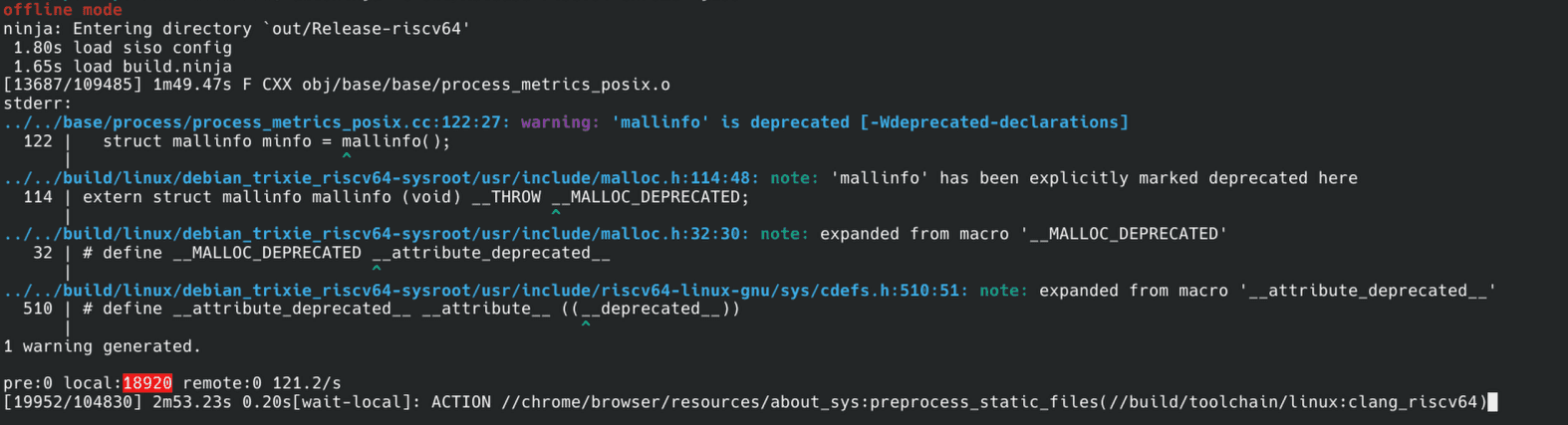
Feel free to upload a CL to fix them.
Aside from that, a linker warning is expected:
Hard-float 'd' ABI can't be used for a target that doesn't support the D instruction set extension (ignoring target-abi)
This is an LLVM bug that causes the generated CFI functions to lack desired target attributes. It is harmless here but a little annoying.
Package
First, strip Chromium, it’s too large if not stripped.
autoninja -C out/Release-riscv64 chrome.stripped
Then we can use the following simple script to create a tarball of Chromium:
#!/bin/bashOUT=out/Release-riscv64pkgdir=chromium-distmkdir -p "$pkgdir"install -D "$OUT"/chrome.stripped "$pkgdir/chromium"files=( chrome_100_percent.pak chrome_200_percent.pak chrome_crashpad_handler libqt5_shim.so libqt6_shim.so resources.pak v8_context_snapshot.bin # ANGLE libEGL.so libGLESv2.so # SwiftShader ICD libvk_swiftshader.so libvulkan.so.1 vk_swiftshader_icd.json # ICU icudtl.dat)cp "${files[@]/#/$OUT/}" "$pkgdir"install -Dm644 -t "$pkgdir/locales" "$OUT"/locales/*.paktar --zstd -cf chromium-dist.tar.zst --directory="$pkgdir" .
Now you can transfer chromium-dist.tar.zst to real riscv64 board to test the freshly built Chromium!
Note
Chromium provides build targets for creating deb and rpm packages.
But the scripts for generating deb and rpm packages currently does not support RISC-V yet.
# Build debninja -C out/Release-riscv64 "chrome/installer/linux:unstable_deb"# Build rpmninja -C out/Release-riscv64 "chrome/installer/linux:unstable_rpm"
Run
You need a real RISC-V board for testing out the freshly built Chromium binary. IIRC, qemu user-mode emulation cannot run Chromium. You might also try to run it inside a qemu-system emulated virtual machine but that would be very slow and you need to be patient.

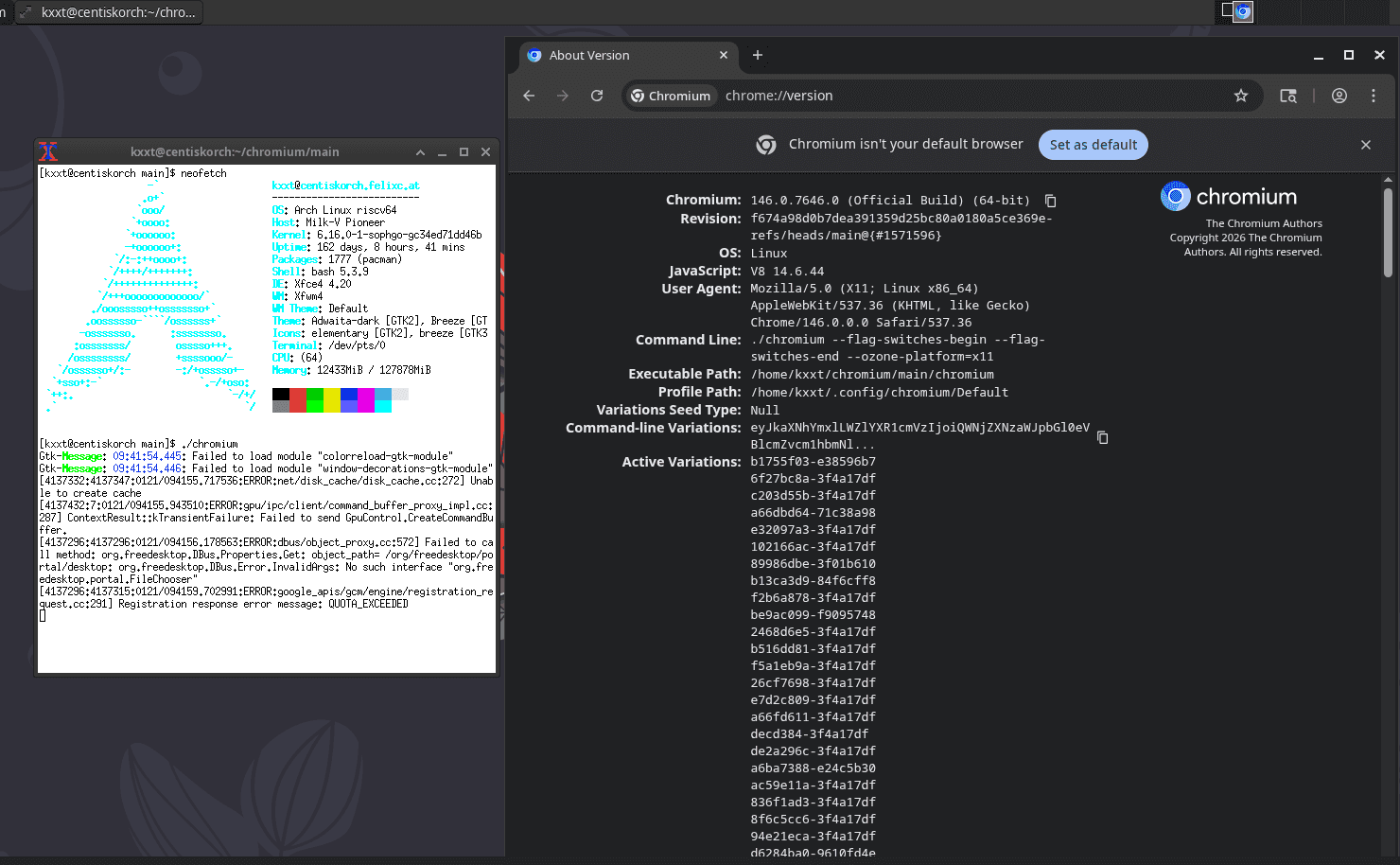
Here’s a screenshot of my build running on Arch Linux RISC-V:
What’s Next
Congratulations! You have successfully compiled Chromium to RISC-V and ran it on a real RISC-V board.
Naturally, it is time for setting up CI/CD for automating your Chromium builds.
Personally, I maintains a downstream CI but no continuous delivery for Chromium. If you set up a continuous delivery pipeline for RISC-V Chromium, please comment and let me know 🥰.
I do have a continuous delivery pipeline for Electron RISC-V, which is a Chromium-based framework for creating cross-platform applications with web technologies.
You may also read the old blog post I wrote in 2024, which contains much more (outdated) details. That is still valuable for compiling old versions of Chromium.
Acknowledgements
The comics in this blog post are from XKCD and licensed under a Creative Commons Attribution-NonCommercial 2.5 License. Some of them are modified.
Special thanks to felixonmars for providing me remote access to the Milk-V Pioneer box, which I could test my Chromium builds on.
If you find this blog post helpful, you can sponsor my open source work via GitHub Sponsors. Your sponsorship would contribute significantly to the long-term sustainability of my open-source projects.